How Talent and Industry are Shaping the Adelaide Economy: Latest Data4Lunch Serves Up Job Market Insights
Adelaide’s next jobs surge will be driven by the city’s fast-growing healthcare, construction, professional, scientific and technical services sectors, new data shows.
Figures shared at the latest AEDA Data4Lunch event, held on 12 November 2025 at the Adelaide Marriott Hotel, showed growing opportunities and business numbers, particularly in financial investment, engineering and specialist medical services fields.
Emerging employment areas included software, data and AI, cybersecurity, biotech, fintech, gaming, space and defence, with strong demand further reflected in the growing investment in innovation precincts like Lot Fourteen and Adelaide BioMed City.
Jordon Tomopoulos, Economic Research Advisor, Data & Insights at AEDA, Scott Philp, Acting Senior Manager of Workforce and Planning Analysis at the Department of State Development and Jane Johnston, Chief Executive of StudyAdelaide, unpacked the data behind Adelaide’s evolving employment landscape at the event.
Read on to discover the jobs in high demand, the impact of international students on the market and the evolving methods of attracting talent, including why embracing AI is key to future success.
Quick reads:
The People Who Power the City: Why All Workers Matter
How Artificial Intelligence is Helping (and Not Taking Your Job)
Changing Roles, Changing Work: What Recruiters are Looking For
Why International Students Play Such an Important Role in Adelaide’s Workforce
The Future of Work: Statewide Job Changes Ahead

Speaking at the event, Mr Tomopoulos noted that as businesses expand and move into the city, they generate a flow-on effect, attracting complementary industries such as maintenance and legal services.
Currently, professionals make up the highest proportion of city workers, followed by clerical and administrative workers, and managers. The lowest proportion of workers were machinery operators and drivers, labourers and sales workers, which tend to be distributed in greater Adelaide.
The City of Adelaide has experienced record-breaking employment growth, reaching unprecedented highs of up to nine per cent year-on-year growth from 2022 to 2023. This growth outpaced the overall South Australian average, solidifying the city’s position as an ideal location for talent to be attracted to and retained.
These optimistic figures followed the Business Council of Australia's announcement of its latest Regulation Rumble report, which labelled South Australia as the best place to do business in the nation for the third consecutive year.
The report highlighted the state’s competitive payroll tax settings, planning system and licensing requirements among strong drawcards.
The People Who Power the City: Why All Workers Matter
Data showed that 29 per cent of all city users were workers—double the proportion of students.
According to AEDA data, approximately 172,000 people are employed within the City of Adelaide. The city also experienced growth of about 22,593 roles, marking a 19 per cent increase on pre-COVID-19 numbers.
Mr Tomopoulos said city workers, on average, would spend approximately $72 a day, totalling $275 a week.
“That accounts for about $200 million per month that, collectively, we're all spending.”
“When you add all that up over a year, collectively, as the city's workforce, we're spending almost $2.5 billion,” Mr Tomopoulos said.
Productivity-wise, each full-time worker contributes approximately $170,000 in average economic value over a year, with those in financial and insurance services providing the highest value-added contribution of $355,000.
How Artificial Intelligence is Helping (and Not Taking Your Job)
Artificial intelligence should be embraced by city businesses and not feared, according to Mr Tomopoulos.
“AI adoption is only in its infancy here and, as demand increases, so will jobs in the data economy,” Mr Tomopoulos says.
“We have great data infrastructure, with the intelligence and skills coming out of the universities, organisations and companies leading the way globally.
“But to be honest, we have so much untapped potential, as public and private struggle to adopt AI.”
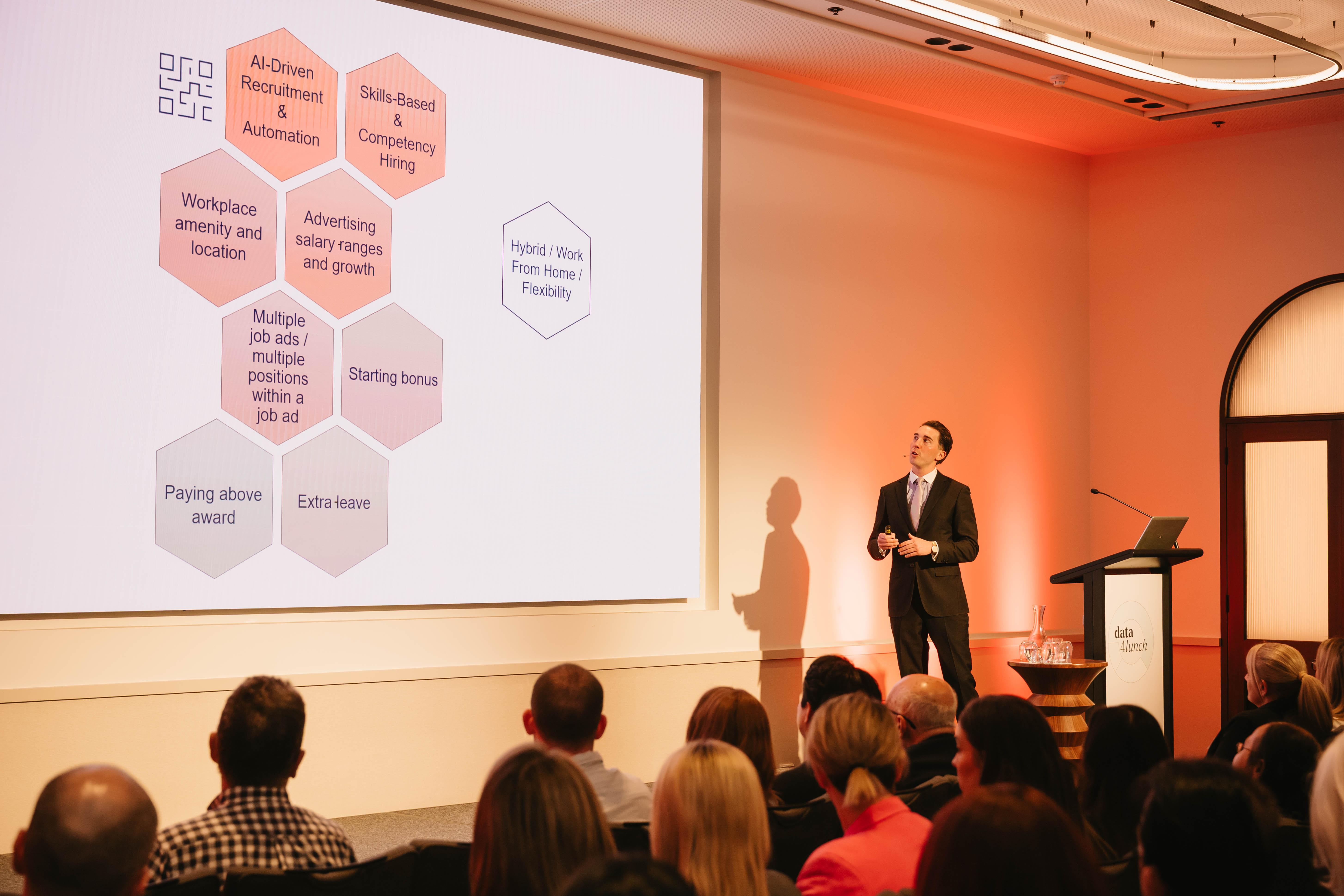
Recruitment is also evolving as firms and job seekers are turning to AI to assist in the recruitment process.
“People are using AI not just to improve their CVs and their cover letters but (also) on the business end, they're using it to scan CVs to do that early round analysis,” Mr Tomopoulos said.
Mr Tomopoulos reassured attendees that AI was not edging humans out of the workforce but rather providing tools to uncover new opportunities and keep relevant in the ever-changing job space.
Changing Roles, Changing Work: What Recruiters Are Looking For
The recruitment rate in the city has remained relatively stable, with new roles accounting for approximately 30 per cent of total hiring, and staff turnover comprising roughly 60 per cent.
This information comes as the most recent Recruitment Experiences and Outlook Survey revealed that hiring managers have found it less difficult to recruit.
Data from SEEK showed Adelaide recorded the highest growth in job advertisements nationally since February 2020, at 46 per cent. Some employers used multiple job advertisements and positions within a job to attract more candidates.
Up to August this year, most job ads in Greater Adelaide were for engineers (1,219), construction labourers (753) and sales assistants (603).
Mr Tomopoulos said employers no longer considered a degree as the primary element to filling a role and, instead, placed greater weight on demonstrable skills, micro-credentials and adaptability.
Advertising salary ranges to attract more candidates, paying above award, offering starting bonuses and giving other incentives such as an extra week of leave and workplace flexibility were also being adopted by employers.
Why International Students Play an Important Role in Adelaide’s Workforce
StudyAdelaide Chief Executive Jane Johnston highlighted the vital contribution international students make to Adelaide’s economy.
StudyAdelaide data showed 59,000 international student enrolments in 2024 in courses across South Australia.
“There are thousands of students who are going to go on to graduate at the end of this year with a qualification in an area of workforce need,” Ms Johnston said.
“These students, having studied and lived here, have a familiarity of the city, and have a local qualification.
“Many of them have also had integrated work experiences while they have been studying.”
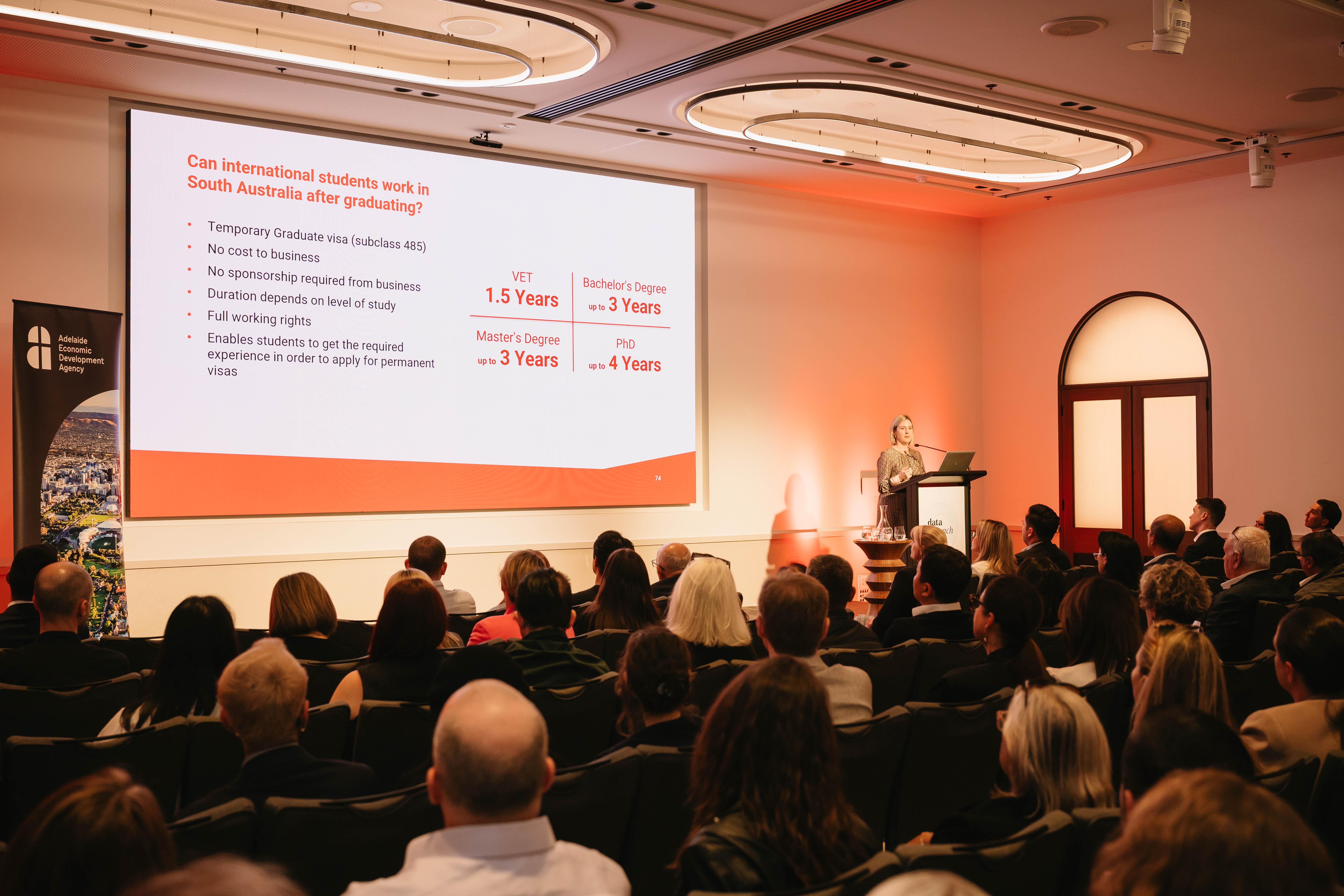
Ms Johnston encouraged employers to consider international students for meaningful roles, as they have full working rights under the Temporary Graduate visa (subclass 485). Depending on the certification attained, visas can range from 18 months for VET graduates to up to four years for PhD graduates. As data shows most people remain in a job for one to four years, this makes international students a practical and valuable hiring choice.
Ms Johnston said students are also bringing professional experience, with many having worked in their home country before deciding to study in Adelaide.
“It might not be a brand name that you recognise in South Australia, but it might be a massive conglomerate in another part of the world,” she said.
The Future of Work: Statewide Job Changes Ahead
The state’s workforce is projected to expand significantly over the next decade, with new figures pointing to strong growth across key industries.
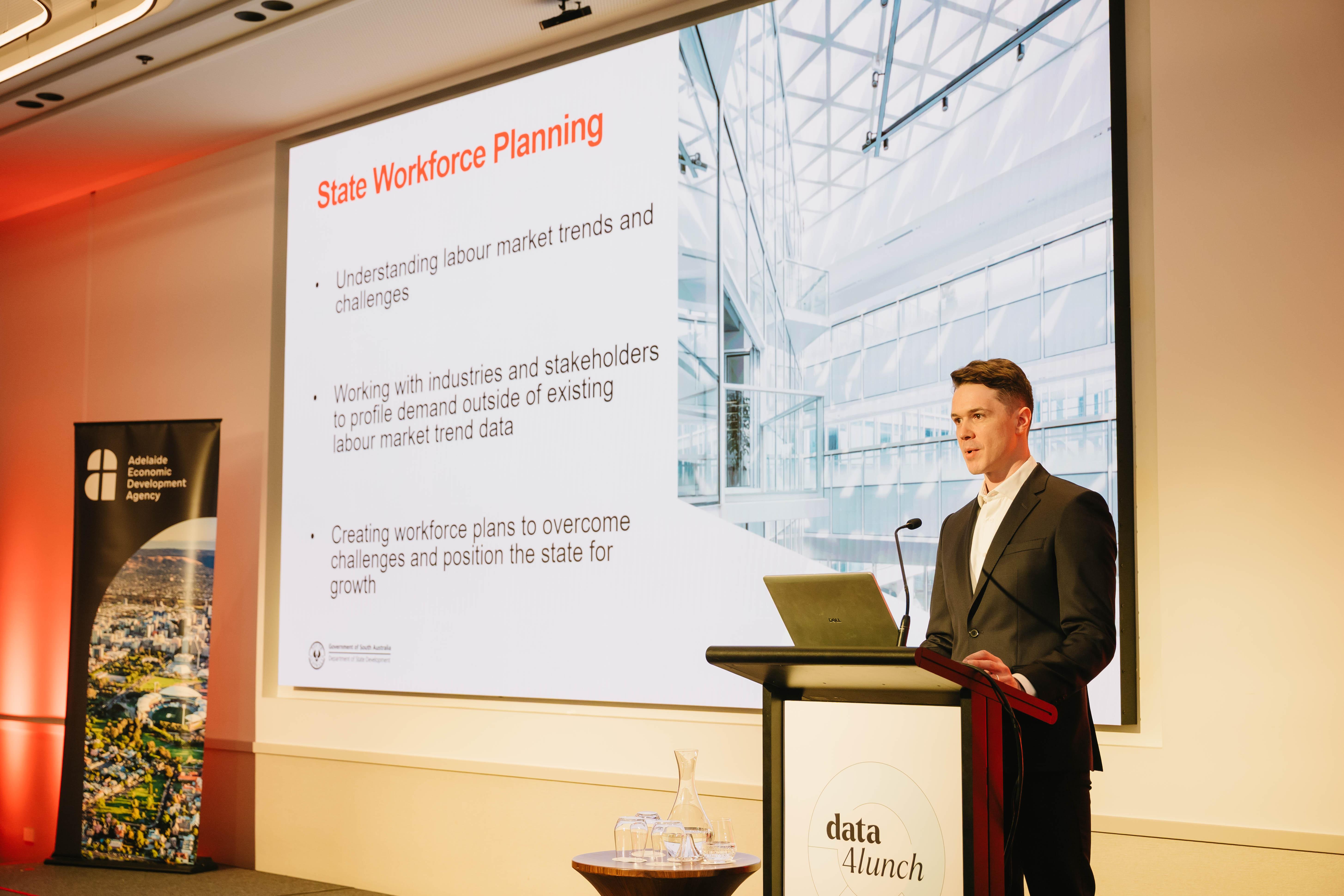
Guest speaker Scott Philp, Acting Senior Manager of Workforce and Planning Analysis at the Department of State Development, projected South Australia would see strong statewide growth.
According to Mr Philp, healthcare, retail, education and construction will be among the sectors driving demand for new workers over the next 10 years.
His data showed the share of professionals across the state would rise to 25 per cent by 2035.
Jobs in community and personal services are projected to increase by 20 per cent, while technicians and trades workers are expected to grow by 12 per cent over the same period.
Mr Philp said the figures highlighted the importance of skills development and workforce planning to ensure the state can meet future labour demands.
“Underlying skill levels are changing in the workforce and, already, we’re moving to a much higher-skilled workforce that requires more training to do the jobs they need to do,” Mr Philp said.
Mr Philp expected the demand for trades – including electricians, construction managers, plumbers and carpenters – IT workers, personal carers and welfare support officers and professional services to be in high demand within 10 years.
Still hungry? Feed your data appetite anytime, anywhere with AEDA’s interactive dashboards packed with the latest insights.
To be the first to hear about upcoming AEDA events, subscribe to City Business here.